

Cloud infrastructure is becoming more complex. As a result, teams require more effective methods for handling changes safely and consistently. Do you already work with cloud-native systems or DevOps practices? Then you might already be using Terraform to define and administer infrastructure.
Terraform Cloud Agents are now a significant part of the modern infrastructure strategy. They enable you to operate Terraform securely, reliably, and at scale. We will look at them in more detail below.
What are Terraform Cloud agents?
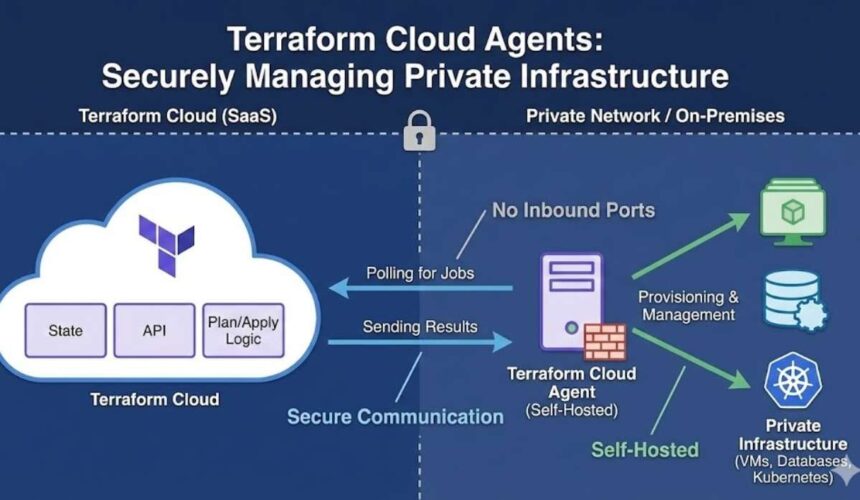
These are worker processes that execute Terraform jobs on your own infrastructure rather than on the shared environment of Terraform Cloud. You deploy and operate these agents within your own network. It could be in either a virtual private cloud or an on-premises setup.
When you initiate a Terraform plan or apply it in Terraform Cloud, the agent picks up the job and executes it locally. This also enables you to maintain sensitive systems, networks, and credentials private and still collaborate and govern with Terraform Cloud.
How they favor cloud-native architectures
Cloud-native architectures are designed on the basis of microservices, dynamic infrastructure, and continuous changes. This model views infrastructure as code and updates it frequently. The Terraform Cloud Agents are ideal for this practice. They allow you to implement infrastructure changes near your resources.
When you run agents within your cloud environment, there is no exposure of private endpoints to the public internet. This comes in handy, particularly when handling:
- Private Kubernetes clusters
- Internal databases
- Limited APIs.
It provides the scalability of cloud-native, but with high security boundaries.
Conforming to DevOps practices
DevOps is concerned with:
- Automation
- Uniformity
- Shared accountability.
The Terraform Cloud Agents help to achieve these objectives. This is made possible by standardizing the implementation of infrastructure changes. Changes are run through a controlled and repeatable process. Simply put:
- You rely on Git as the source of truth
- Run Terraform Cloud
- Delegate execution to agents.
This prevents human error. It also eliminates the reliance on individual machines and ensures that all changes are performed through the same workflow. It simplifies collaboration, reviewing of changes, and rollback of teams.
Enhancing security and control
One of the key issues of modern infrastructure is security, especially as teams work to reduce exposure to modern cyber security threats. Terraform Cloud agents allow you to mitigate risk by keeping Terraform runs inside your own environment rather than a shared, multi-tenant platform. By storing credentials and network access within your infrastructure, no secrets have to be disclosed to outside systems and access can be tightly restricted, complementing broader best practices for defending against common cyber security threats as outlined in this detailed guide
It is also possible to separate agent pools across environments, e.g., development and production. This reduces the effects of errors and enables you to use greater controls where they are most needed.
Supporting growth and scale
Manual processes become ineffective as your infrastructure scales. Terraform Cloud Agents support scaling by enabling a number of teams to execute Terraform concurrently without interference. When the demand grows, you can add more agents. As a result, infrastructure changes will be quick and dependable.
Summing up
Terraform Cloud Agents are becoming important in the contemporary approach to infrastructure because they help to bridge cloud-native and DevOps practices. They enable you to operate Terraform safely in your own environment while still achieving automation, consistency, and collaboration. Agents provide a viable and scalable solution to current infrastructure requirements in case you need more control without losing the advantages of Terraform Cloud.