

From Fortune 500 companies to startups, cloud infrastructure powers everything from app deployments to data analytics and machine learning models. As a result, there has been an increase in the number of beginners. From students to those changing careers, they find themselves questioning whether learning AWS Cloud Practitioner is beneficial before grasping DevOps or AI.
Insights:
It’s tempting to dive right into tools like Docker, Kubernetes, Python, TensorFlow, or machine learning frameworks. This is because DevOps and Artificial Intelligence (AI) are frequently promoted as “high-paying,” “future-proof,” and “in-demand” job pathways.
Boot camps and social media courses frequently promote this fast-track method.
In reality, however, many students struggle not because these tools are difficult to use, but because the underlying principles of cloud computing are not well understood.
Ideas seem disjointed. Troubleshooting gets annoying. Learning becomes slower.
This is precisely the point at which the AWS Cloud Practitioner certification (CLF-C02) becomes relevant.
This guide focuses on Indian and international job seekers. We will examine whether the AWS Cloud Practitioner certification is worthwhile and how it fits into a beginner’s AWS certification roadmap. Additionally, we will explore whether it actually adds value before specialising in DevOps or AI.
What Is AWS Cloud Practitioner (CLF-C02) and Who Is It For?
The CLF-C02 is the foundational-level certification that AWS offers. Cloud Practitioner does not involve actual programming or architectural design skills, unlike associates’ or professionals. Instead, it focuses on conceptual clarity, which beginners often lack.
It is meant for those who want to understand what cloud computing is, how AWS works, and why organisations use AWS without requiring a lot of technical or coding expertise. This makes it particularly meant for:
- Newcomers to cloud or IT positions
- Students in college and recent grads
- Professionals who are not technical but are moving into technology
- Early-stage candidates for AI or DevOps
- Project managers, business analysts, or salespeople collaborating with cloud teams
This certification serves as the first formal introduction to cloud computing for many students.
What Topics Are Covered in AWS Cloud Practitioner Certification?
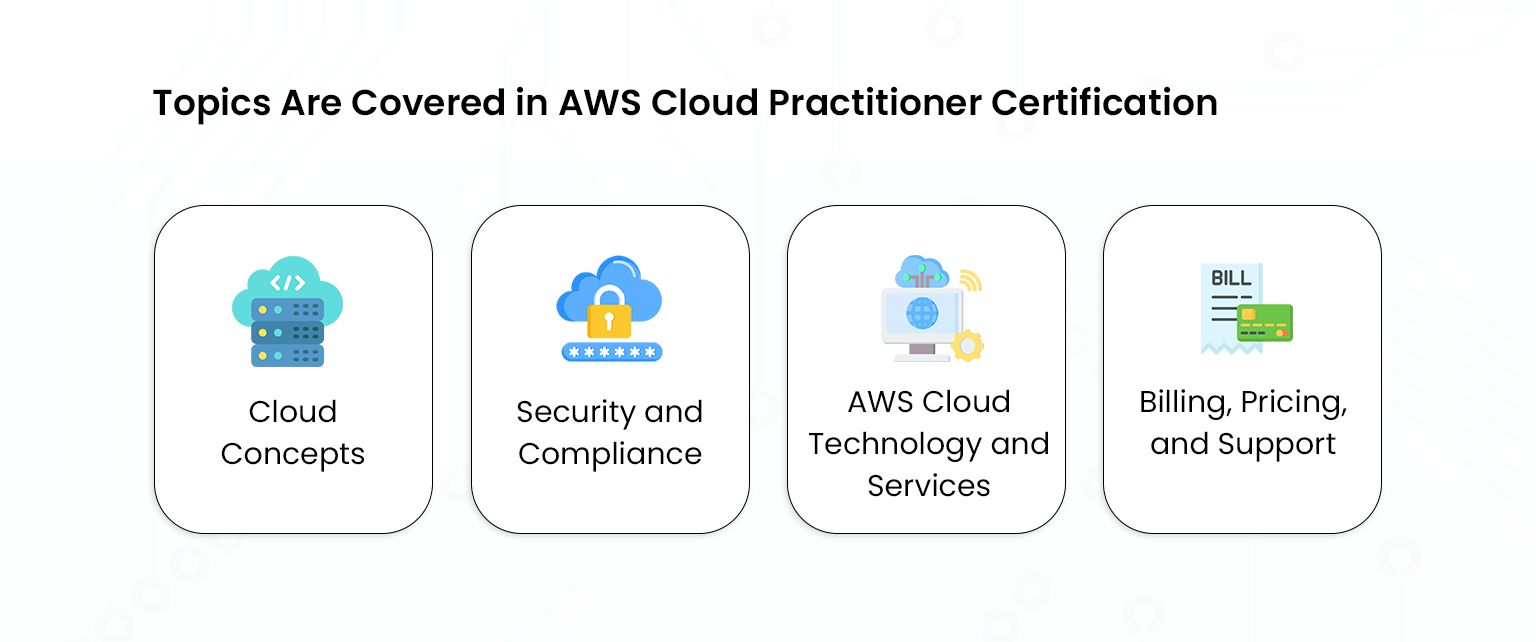
The structure of the AWS CLF-C02 exam is explicitly reflected in these four domains, which are more than just learning subjects. These topics are usually the focus of training programs like Whizlabs’ AWS Cloud Practitioner preparation, which makes it easier for newbies to study methodically while staying aligned with actual test requirements.
1. Cloud Concepts
The definition of cloud computing, how it varies from conventional on-premises infrastructure, and the various cloud deployment models, such as public, private, and hybrid, are all covered in this section.
Key features include fault tolerance, scalability, elasticity, and high availability, as well as information about AWS’s worldwide architecture, including availability zones and regions.
For beginners, this part provides a solution to a fundamental yet important query: Why do businesses initially migrate to the cloud?
2. Security and Compliance
For businesses using the cloud, security is a top priority. The AWS shared responsibility model, Identity and Access Management (IAM) principles, fundamental security services, and best practices are all introduced to students in this domain. Compliance requirements pertinent to the regulated industry are also included.
It is crucial for DevOps and AI workers who manage production systems and sensitive data to understand who is in charge of what in the cloud.
3. AWS Cloud Technology and Services
This domain introduces key AWS services at a high level, including:
- Compute: EC2, Lambda
- Storage: S3, EBS
- Databases: RDS, DynamoDB
- Networking: VPC, security groups
- Monitoring: CloudWatch
Rather than teaching how to configure these services, the certification explains what problems they solve and when they are used. This conceptual understanding is invaluable before hands-on learning.
4. Billing, Pricing, and Support
This is one of the exam’s most useful but underappreciated sections. It covers cost optimization concepts, AWS support plans and invoicing tools, and AWS pricing methods (pay-as-you-go, reserved instances, savings plans).
Before they encounter unforeseen cloud costs, many newbies overlook them. Early cost awareness is developed in this part, which is crucial in real-world cloud environments.
These four key areas covered by the AWS Cloud Practitioner certification combine to provide a solid understanding of AWS and cloud computing. It also offers a high-level overview of Artificial Intelligence (AI) and Machine Learning on AWS.
This certification is purposefully made to lessen complexity, uncertainty, and fear for anyone looking for an AWS Cloud Practitioner for beginners.
Why Beginners Struggle in DevOps or AI Without Cloud Fundamentals?
Beginners in DevOps and AI frequently leap right into tools without first developing a solid understanding. While AI learners usually start with Python, TensorFlow, PyTorch, or ML techniques, DevOps learners frequently start with platforms like Docker, Kubernetes, or Jenkins.
The Missing Layer Most Beginners Ignore: Cloud Context
Most real-world DevOps and AI workloads run on cloud platforms like AWS. Without understanding:
- What an EC2 instance actually represents
- How cloud networking differs from local networking
- Why IAM and access policies exist
- How cloud pricing affects architecture decisions
Learning becomes fragmented and frustrating.
For example, a beginner might learn Kubernetes commands but not understand where the cluster runs, how networking works, or why permissions fail. Similarly, AI learners may train models locally but struggle to deploy them at scale.
This is why the AWS Cloud Practitioner certification often acts as a stabiliser, helping learners understand where their tools actually live and operate.
Hands-on experience makes a discernible impact on this gap. With guided cloud laboratories that let newbies observe services like EC2, IAM, and VPCs in action, platforms like Whizlabs augment theoretical learning.
When students engage with DevOps or AI technologies later on, even a small amount of hands-on experience helps them make the connection between abstract ideas and actual cloud environments.
Is AWS Cloud Practitioner Worth It for Beginners in 2026?
Is AWS Cloud Practitioner Worth It?
Yes, it is. AWS Cloud Practitioner is worthwhile for beginners, especially those with little to no experience with the cloud.
When does an AWS Cloud Practitioner Add Real Value?
Whether it is worth it or not depends on your starting point.
| Learner Profile | ✓ Is AWS Cloud Practitioner Worth It? |
| Non-IT / Career Switcher | ✓Highly valuable |
| College Student / Fresher | ✓Strong foundation |
| DevOps Beginner | ✓Recommended |
| AI Beginner | ✓Useful |
| Experienced AWS User | x Optional |
The AWS Cloud Practitioner certification offers instant benefits if concepts like regions, availability zones, IAM, or pay-as-you-go pricing are still confusing.
Why Should You Learn AWS Cloud Practitioner Before DevOps?
I. Is Cloud Knowledge Essential for DevOps Beginners?
DevOps encompasses more than just automation tools. In practical roles, DevOps specialists are responsible for managing cloud infrastructure and ensuring that installations are scalable and fault-tolerant.
They also oversee security and access control to protect data and systems, and they continuously optimize resources to build and maintain cost-effective systems that satisfy business goals.
DevOps tools frequently feel abstract and detached from actual systems in the absence of cloud basics.
II. How AWS Cloud Practitioner Certification Helps DevOps Beginners?
Before entering DevOps, you can have a thorough understanding of the fundamental AWS infrastructure building blocks and how cloud services work together by earning the AWS Cloud Practitioner certification. Additionally, it provides you with a strong basis for secure system design by introducing you to shared responsibility and cloud security boundaries.
Additionally, you learn about fundamental networking concepts like VPCs and subnets and develop cost awareness, which is a crucial but frequently disregarded ability for anyone working in real-world DevOps scenarios.
For individuals who are new to DevOps, especially those who are beginning from scratch, this makes it a powerful cloud certification.
III. DevOps Learning Path After AWS Cloud Practitioner
A common learning progression looks like this:
- AWS Cloud Practitioner
- Linux fundamentals
- Git and version control
- Docker and containerization
- Kubernetes and orchestration
- CI/CD pipelines and Infrastructure as Code
Rather than slowing you down, AWS Cloud Practitioner before DevOps often accelerates long-term understanding.
Is AWS Cloud Practitioner Useful Before Learning AI or Machine Learning?
AI and machine learning rarely operate in isolation today. Most AI systems rely on cloud infrastructure for:
- Large-scale data storage
- Compute-intensive model training
- Model deployment, monitoring, and scaling
AWS Cloud Practitioner vs Associate-Level Certifications
Some students think about going straight to associate-level certifications like AWS Solutions Architect Associate instead of Cloud Practitioner.
➔ When You Should Not Skip AWS Cloud Practitioner Certification?
- You are new to cloud computing
- You feel overwhelmed by AWS terminology
- You lack hands-on infrastructure experience
➔ When Can You Skip AWS Cloud Practitioner Safely?
- You already work with AWS services
- You have strong Linux and networking knowledge
- You’ve deployed applications on cloud platforms
For most beginners, AWS Cloud Practitioner reduces early confusion and learning fatigue, making advanced certifications easier later.
AWS Cloud Practitioner Career Path and Next Certifications
The AWS Cloud Practitioner career path is flexible and does not lock you into a single role.
After completing it, you can move into:
Cloud Support and Operations Roles
- Cloud support engineer
- Cloud administrator
- Technical consultant
AI-Oriented Roles
- AWS Solutions Architect Associate
- AWS Machine Learning Specialty
- AI/ML engineering paths
DevOps-Oriented Roles
- AWS Solutions Architect Associate
- AWS SysOps Administrator
- DevOps Engineer roles
This flexibility makes it a natural first step in a beginner AWS certification roadmap.
Can AWS Cloud Practitioner Help You Get a Job?
This is where honesty matters.
What It Helps With
- Building cloud literacy
- Strengthening fresher and junior resumes
- Supporting interviews and internal role changes
- Improving confidence before advanced certifications
What It Does Not Do
- Guarantee a job
- Replace hands-on skills
- Independently prepare you for positions in DevOps or AI.
Think of it as a starting point instead of a finish line.
AWS Cloud Practitioner Exam Overview (CLF-C02)
- Level: Foundational
- Duration: 90 minutes
- Questions: 65
- Price: $100 USD
- Difficulty: Suitable for beginners
Instead of rote memorising, the CLF-C02 version prioritises real-world cloud comprehension.
Mock tests are essential for preparation because the CLF-C02 exam emphasises comprehension of real-world situations rather than memorisation.
Exam-aligned practice exams, such as those provided by Whizlabs, give students a better understanding of scenario-based questions and boost their confidence prior to the test.
AWS Cloud Practitioner Value in India and Global Job Markets
Why AWS Cloud Practitioner Makes Sense in India
In India, cloud awareness is increasingly expected across:
- IT services and consulting firms
- SaaS startups
- BFSI, fintech, and e-commerce companies
- MNCs supporting global cloud clients
Even for entry-level roles, basic cloud knowledge is often assumed. The AWS Cloud Practitioner certification helps bridge this expectation gap.
Value for Global and Overseas Aspirants
For professionals targeting:
- Remote cloud roles
- Overseas job opportunities
- Global DevOps or AI teams
This certification demonstrates internationally recognised cloud fundamentals, making profiles more globally aligned.
Frequently Asked Questions About AWS Cloud Practitioner
1. For beginners in India, is AWS Cloud Practitioner worthwhile?
Indeed. The AWS Cloud Practitioner certification is worthwhile for Indian newcomers, recent graduates, and job changers since it develops the cloud principles required by numerous training programs and businesses.
2. Should I finish AWS Cloud Practitioner before learning DevOps?
Yes. AWS Cloud Practitioner helps you understand the cloud infrastructure on which DevOps tools operate. Completing it before learning DevOps makes the learning process simpler and more effective.
3. Before learning AI, is AWS Cloud Practitioner helpful?
Indeed. Understanding data, computing, security, and pricing in cloud-based AI systems is made easier with the AWS Cloud Practitioner before AI.
4. Can I get employment with an AWS Cloud Practitioner certificate?
It improves employability and interview readiness, but it needs to be combined with role-specific training and practical skills to land a job.
5. Does AWS Cloud Practitioner have international recognition?
Indeed. In the US, Europe, the Middle East, and Asia-Pacific, the AWS Cloud Practitioner certification is highly recognised.
6. Now that I am an AWS Cloud Practitioner, what should I do?
It’s a great place for beginners to begin their AWS certification journey because you may go into DevOps, AI, or advanced cloud certifications based on your career goals.
Final Verdict: Should You Start with AWS Cloud Practitioner Before DevOps or AI?
For beginners, the answer is clear!
Before committing to DevOps or AI, AWS Cloud Practitioners, it won’t turn you into an expert, but it will help you avoid learning in the dark.
It’s not that AI or DevOps are too difficult; rather, a lot of specialists struggle because they neglect the fundamentals. You can move on with great clarity and confidence if you start with AWS Cloud Practitioner.
In cloud careers, clarity is equally crucial yet undervalued. Get your basics right and strong!