

Last Updated: June 26, 2026
Why verified, expert built datasets keep accuracy steady once the training run gets serious.
Quick Answer
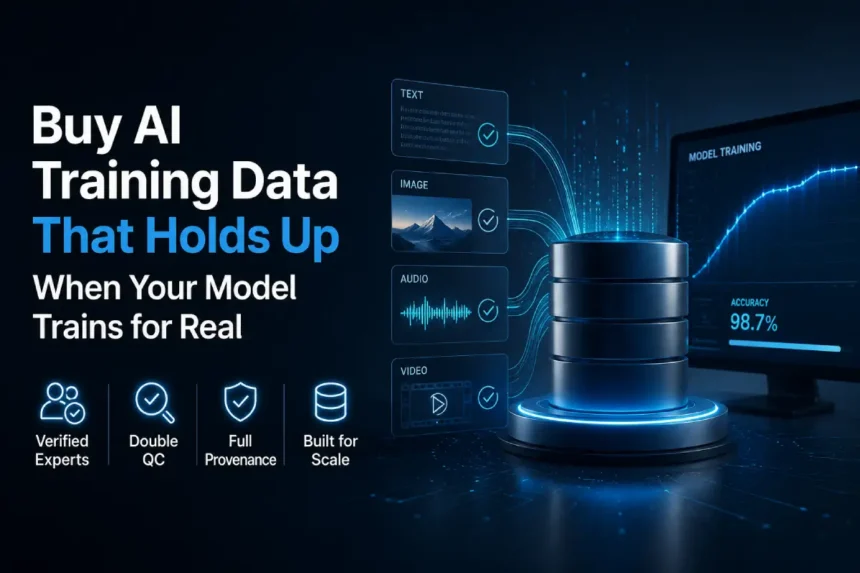
Plenty of teams buy AI training data that looks spotless in a preview, then watch it crumble once the real run kicks off. Labels slide. Rare cases disappear. Accuracy stalls and no one can explain it. The answer is data made by verified experts, checked twice, and stamped with full provenance. Humyn Labs builds custom ai training data that keeps its accuracy through training, evaluation, and launch. Want proof first? Ask for a scoped sample.
What does buying AI training data that survives real model training mean?
It means data that keeps its label accuracy, domain spread, and rare case coverage at full volume, not only inside a tidy demo batch. Verified human experts gather and check every point, so the set stays solid when your model trains on millions of rows rather than a neat sample. Humyn Labs delivers exactly that, through vetted contributors, two layer quality control, and traceable provenance on every label.
Your model inherits the quality of the data you bought

Run this scene. Your team trains a model for three weeks. Early on the loss curve behaves. Then accuracy goes flat. You start digging, and the trail leads back to a dataset you bought months earlier, the one that seemed flawless in the preview. Silent label errors had been quietly decaying inside it the entire time.
That one stings. It eats GPU budget, drags your launch date, and hands you a model that stumbles on the very inputs your users lean on hardest. Worse, you cannot pin down who labeled the bad rows or why, because no trail exists to follow.
Most buying guides skip the part that actually matters when you buy ai training data. Some datasets are made to win the preview. Others are made to survive the training run. This guide shows you how to tell them apart, and where to find ai training data that genuinely holds. And yes, Humyn Labs sits at the heart of that answer, so I will be straight about the reasons.
The market is surging, but quality lags behind
Appetite for training data keeps rising. The global AI training dataset market stood near 3.59 billion dollars in 2025 and is set to reach 4.44 billion in 2026, heading past 23 billion by 2034 at a growth rate close to 23 percent each year. North America still owns the largest share at roughly 35 percent.
Raw spending masks a problem, though. Buyers keep moving away from cheap bulk data toward high quality, domain specific datasets, because that is the real source of model accuracy. Multimodal data is the quickest growing slice, outpacing every other modality through the decade. Here is the snag. Multimodal ai training data, the voice, image, video, and sensor kind, barely exists at real quality. No marketplace lets you browse it. You need someone to build it.
Money is flooding in. Demand is real. Good data stays scarce. And the bigger the market grows, the more weak data slips through unnoticed, straight into pipelines like yours.
Why most AI training data breaks the moment you scale
Cheap data tends to look great right up to the point it counts. Here is how it falls apart.
The preview shines, the full set does not
Vendors polish the demo batch by hand. But quality slips the moment volume climbs, because the care poured into 500 rows cannot stretch across 5 million. You bought the preview. You got something different.
Crowd labeling buries silent errors
Anonymous crowd workers guess on the fuzzy cases. One labeler calls a blurry photo a dog. Another says wolf. Nobody verifies. Those tiny disagreements stack across millions of rows, and your model absorbs the confusion. This is the root flaw in the crowd sourced approach that older marketplaces and providers like Appen relied on for years.
The rare cases quietly vanish
Real models break on edge cases. The unusual accent, the strange lighting, the legal phrasing nobody planned for. Cheap datasets dodge these because they are slow and costly to gather. So your model ships blind to the 5 percent of inputs that trigger 95 percent of your production failures.
No trail means no accountability
When labels go wrong, you want to know who made them and why. Most data arrives with zero provenance. You cannot trace it. You cannot fix it at the source. You just relabel and hope. Tired of guessing? Begin with data quality assurance you can audit.
| One question that filters out weak vendors
Ask any provider this. Will you show me accuracy across the full delivery, not the preview? Hesitation tells you everything you need. |
What surviving real model training actually means
Strong data carries four traits. Drop any one and the set starts to wobble under load.
Accuracy that stays put at volume
The bar is plain. Accuracy measured across the entire dataset, not a flattering slice. Humyn Labs runs the same accuracy at one million rows as at one thousand, because the checks scale alongside the data instead of thinning out.
Coverage across every modality your model touches
Text, voice, image, video, audio, sensor. Real deployment is multimodal, so your training data has to match. A medical imaging model needs expert labeled radiology scans. A voice model needs accented speech across genuine demographics. A humanoid robot needs first person footage of people doing actual work. Generic text data will not carry you there.
Edge cases and adversarial inputs, by design
The best datasets deliberately fold in the hard cases. Red teaming inputs, preference pairs, the awkward 5 percent. This separates a model that demos cleanly from one that survives the wild.
Provenance you can actually prove
Every label should trace back to a credentialed expert. This is where the Proof of Expert model shifts the game. Each contributor holds an on chain identity, which is simply a permanent record of their skills and work that nobody can quietly edit later. You are not trusting a faceless crowd. You are buying verified ai training data with a paper trail.
The real cost of buying the wrong AI training data
Start with the punchline. The cheapest dataset is the one you end up buying twice. Bad data is never cheap. It just delays the invoice. Here is where the bill lands.
- Wasted compute and engineering hours. Each re training cycle burns GPU spend and salaried time. One bad dataset can swallow weeks of an ML team’s focus.
- Delayed time to market. Every re label loop shoves the launch back. Rivals who got their data right the first time ship while you debug.
- Model risk in production. Bias, hallucination, and failure on the cases your users care about most. The reputational hit from a model misbehaving in front of customers dwarfs the data invoice.

Cheap data against verified data, side by side
| What matters | Cheap crowd data | Verified expert data |
| Preview vs full set | Strong preview, weak at scale | Steady across the full set |
| Who labels it | Anonymous crowd workers | Vetted domain experts |
| Edge case coverage | Mostly skipped | Built in by design |
| Audit trail | None | On chain provenance per label |
| Quality control | Single pass, if any | Two layer, peer plus central |
| Total cost of ownership | Low upfront, high later | Fair upfront, low overall |
That bottom row is the whole argument. So how do you spot the data that holds before you ever pay for it?
How to buy AI training data that genuinely holds up
This is the part that rescues your next training run. Walk these five steps before you buy ai training data from anyone.
- Ask for full set quality metrics, not preview stats. Request accuracy measured across the whole delivery. A confident provider shares it without flinching.
- Vet the annotators, not just the platform. A polished dashboard means nothing if anonymous workers sit behind it. Ask who labels your data and what qualifies them.
- Insist on a trail. Demand traceable labels with provenance. When something breaks, you want to find the root, not redo everything.
- Pilot on your hardest edge cases first. Test on the data that usually breaks your model. Survive that, and the rest follows.
- Pick a partner, not a marketplace. A bulk dump leaves you alone with the fallout. A real partner scopes the work with you. See how Humyn Labs builds to spec.
How Humyn Labs builds AI training data that survives
Humyn Labs fits the brief for one reason. It was built around the exact failures above. Here is what that looks like in practice, through Humyn Labs.
Verified experts, not faceless crowds
Your data comes from vetted domain experts, sourced through continuous evaluation and skill based task routing. No guessing. No mystery labelers. The right person for the right modality and domain.
The Proof of Expert model
Every contributor holds an on chain credential carrying skill scores, performance history, and reputation that updates as they work. This is provenance you can stand behind, and no crowd marketplace can replicate it. It turns trust into something you verify rather than assume.
Multimodal and multilingual from the ground up

Voice, image, video, audio, sensor, document. Plus more than 50 languages including Hindi, Tamil, Telugu, Bengali, Marathi, and other Indic tongues, alongside Mandarin, Japanese, Arabic dialects, and major European languages. If you build for India or emerging markets, this depth is tough to find elsewhere. Explore the voice and speech datasets if speech is your focus.
Double checked quality, every single point
Every point clears two layers. Peer review plus centralized QC. That is the human in the loop layer keeping your data clean before it ever reaches your pipeline. Better data in, better models out.
Built to scale without the quality cliff
The whole system is designed so accuracy does not slide as volume rises. The same standard at scale as in the preview. That is the promise behind the headline, data that survives real model training.
| How fast can you begin?
Tell Humyn Labs what you are building. They scope a custom dataset and project plan within 48 hours. Talk to the team. |
Who needs verified AI training data most
See yourself on this list? Then weak data is a risk you cannot carry.
- Frontier model labs. Custom multimodal sets, paired image text data, multilingual corpora, and instruction tuning at scale, the data used to teach models how to follow directions.
- Voice and speech AI companies. Accented English, Indic languages, emotion tagged speech for ASR and TTS systems.
- Robotics and embodied AI teams. First person video of people doing real tasks, the highest leverage input for manipulation learning.
- Teams building for India and emerging markets. Deep Indic language coverage that most providers simply lack.
Common mistakes to avoid
The same buying errors repeat across teams. Dodge these and you are already ahead of most.
- Judging a dataset by its preview. The preview is the pitch, not the product.
- Treating every modality as equal. Multimodal data is far harder to get right than text.
- Ignoring provenance until something breaks. By then tracing it is too late.
- Grabbing the cheapest set to save budget, then paying triple in re training.
- Choosing a marketplace when you needed a partner.
Frequently asked questions
How much does it cost to buy AI training data?
Cost depends on modality, volume, domain complexity, and language needs. Voice collection prices differently from image annotation or first person video. Humyn Labs scopes each project on its own and shares clear pricing before you commit, so you request a custom quote rather than guessing off a rate card.
How is verified AI training data different from crowd sourced data?
Crowd data comes from anonymous workers with no accountability. Verified ai training data comes from vetted experts whose work is tracked, scored, and traceable. The accuracy gap shows up fast once your model trains on the full set.
Can I get a sample before committing?
Yes, and you should. Request a scoped sample and pit it against your hardest edge cases first. Strong data survives that test. Weak data shows its cracks right away.
What data modalities does Humyn Labs support?
Voice and speech, image, video, audio, sensor, and document data, plus cross modal paired sets like video with synced transcripts. If your model needs more than text, the training data covers it.
How fast can you deliver a custom dataset?
Scoping happens within 48 hours of your first conversation. Delivery timing tracks volume and modality, but you get a clear project plan up front, not a vague promise.
How do you guarantee label accuracy at scale?
Every point clears double verification, peer review plus centralized QC, and each label ties to a credentialed expert through on chain provenance. The checks scale with the data, so accuracy stays level as volume grows.
Buy data that survives, not data that demos
Your model carries the quality of its data for good. Feed it clean, verified, expert built ai training data and it learns the right patterns. Feed it cheap crowd guesses and it learns the noise. There is no patching that later without starting fresh.
So before you buy ai training data again, run the five step check. Demand full set metrics. Vet the people. Insist on provenance. Pilot the hard cases. Choose a partner. And for a head start, Humyn Labs will scope a sample you can stress test before a single dollar moves.
Test the data on your worst edge cases first. Talk to Humyn Labs and see what survives.