

Last Updated: April 27, 2026
The Rise of Immersive Experiences
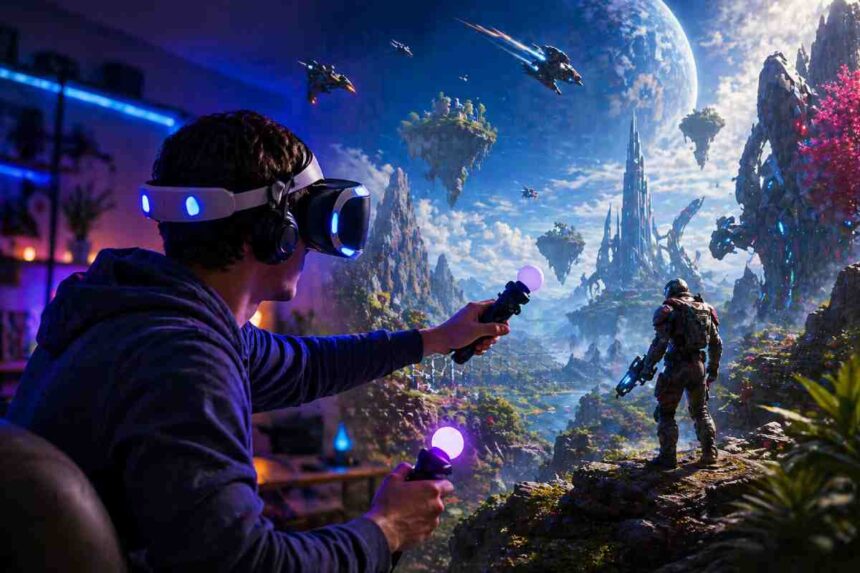
In recent years, virtual reality (VR) has transformed from a niche technology into a significant force within the gaming industry. As hardware becomes more accessible and software continues to innovate, players are finding themselves immersed in worlds that were once only imaginable in science fiction. The evolution of VR gaming is not merely a trend; it is a leap into a new dimension of interactive entertainment. While traditional gaming platforms still hold a significant market share, VR’s ability to offer immersive experiences is reshaping how players interact with games.
The integration of VR technology into gaming allows for a level of immersion that traditional platforms simply cannot match. Players can now physically move within a game world, interact with their surroundings, and experience narratives in a way that feels personal and engaging. This level of interactivity is reminiscent of how Football Predictions offer fans a way to engage with sports outcomes, providing a personal stake in the events they follow.
Challenges in VR Gaming Development
Despite its potential, VR gaming faces several challenges that developers must overcome. One of the most significant barriers is the cost associated with VR hardware. While prices have decreased over the years, high-quality VR systems remain out of reach for many consumers. This limitation affects the market penetration of VR games and restricts the audience that developers can target.
Additionally, creating content for VR is inherently more complex than for traditional gaming platforms. Developers must consider factors such as motion sickness, user comfort, and the physical space required for gameplay. These challenges require innovative solutions to ensure that VR gaming is not only immersive but also comfortable and accessible to a broad audience.
Read also: The Evolution of Competitive Gaming: What Lies Ahead for Esports?
The Role of Social Interaction in VR
As VR technology advances, its potential to enhance social interaction in gaming becomes increasingly apparent. Multiplayer VR games are gaining popularity, allowing players to connect with friends and strangers alike in virtual environments. This social aspect of VR gaming is a significant draw for many players, offering a sense of presence and connection that is difficult to achieve through traditional gaming platforms.
The development of social VR experiences is akin to the rise of social features in other industries, such as how Football Predictions allow fans to engage in discussions and debates about potential match outcomes. In VR, players can share experiences, collaborate on tasks, and compete in ways that feel more tangible and immediate than ever before.
The Impact of VR on Game Design
The introduction of VR technology is prompting a reevaluation of game design principles. Traditional game mechanics often do not translate well into VR, necessitating new approaches to storytelling, interaction, and user experience. Developers are exploring innovative ways to leverage VR’s unique capabilities, such as using physical movement as a core gameplay mechanic or creating environments that respond dynamically to player actions.
This shift in game design philosophy is opening up new possibilities for storytelling and player engagement. Games are no longer confined to a flat screen; they can now envelop players in a fully realized world, offering experiences that are as much about exploration and discovery as they are about completing objectives.
Looking Ahead: The Future of VR Gaming
As technology continues to evolve, the future of VR gaming looks promising. Advances in hardware, such as more affordable headsets and improved motion tracking, will make VR more accessible to a wider audience. Additionally, developments in software, including more sophisticated AI and procedural generation techniques, will enable the creation of increasingly complex and immersive game worlds.
The potential for VR to revolutionize gaming is vast, and its impact is already being felt across the industry. As developers continue to push the boundaries of what is possible, players can look forward to a future where the line between reality and virtuality becomes increasingly blurred. In this new era of gaming, the possibilities are as limitless as the imagination itself.